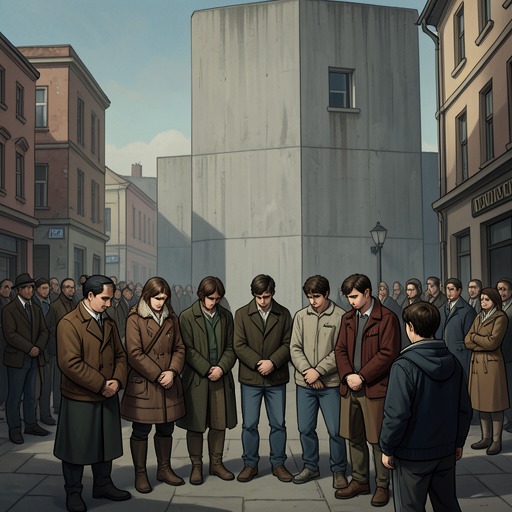
1968–1969 Japanese university protest period
Norwegian WoodThe 1968–1969 Japanese university protest period forms a political backdrop to the narrator’s alienation, but it is not merely background: the strike and its aftermath expose a gulf between revolutionary slogans and the conduct of those who voice them. The university endures, the barricades come down, and the former leaders return to class, leaving the narrator to see political rebellion as compromised by the very structures it claimed to oppose.
Strike and institutional setting
The strike begins at the end of May with calls to dismantle the university. The narrator, already sunk in a private emptiness, responds to the slogans with indifference edged by sudden willingness: he welcomes the prospect of tearing the institution apart and says he would help if necessary. His reaction is not presented as organized political commitment. Rather, the strikers’ destructive language briefly seems to match his own sense that nothing matters and that any rupture might offer relief.
The campus is blockaded and lectures are suspended, sending the narrator to work for a delivery company. He loads and unloads lorries five days a week while continuing three nights of work at a record shop. Physical labor is harder than he expected, but keeping his body moving helps him forget the emptiness. This parallel between campus shutdown and paid work places the protest within a material routine: while political activity halts the university, the narrator’s days fill with strenuous employment rather than activism.
Police intervention and the strike’s collapse
During the summer holidays, the university calls in riot police. They break through the barricades and arrest the students inside. The narrator regards the intervention as part of a familiar pattern, not an unprecedented rupture. He also distinguishes the movement’s public demand from what he believes its participants actually sought: the students had not truly intended to abolish the university, but to shift the balance of power within its existing structure. That institutional objective holds little interest for him.
When the narrator returns to campus in September, he expects to find ruins. Instead, the place is intact: the library’s books remain, the tutors’ offices are not destroyed, and the student-affairs office has not burned. The untouched campus makes the claimed revolutionary break look less like a transformation than a performance bounded by the institution’s durability. The narrator is astonished by the gap between the barricades and what they were supposed to accomplish.
Return to ordinary academic life
Under police occupation, lectures resume, and the first students to take their seats are the people who had led the strike. They take notes and answer the register as though nothing had happened. The narrator sees a contradiction: no declaration has formally ended the strike, yet its leaders behave as if ordinary university life has already resumed. When he asks them why they are attending lectures rather than continuing the protest, they cannot give him a straight answer. He reads their return as evidence that the movement’s most forceful rhetoric could not withstand the prospect of lost attendance marks.
His criticism is aimed not only at the leaders’ inconsistency but at the way revolutionary language turns into routine when the immediate pressure changes. The students who had condemned opponents and subjected doubters to kangaroo courts now sit in class. Their cries for dismantling the university diminish as circumstances shift. The narrator’s contempt for this reversal is sharpened by his address to Kizuki: the dead, he thinks, are spared the spectacle of a society being made in the image of people he despises.
For a time, the narrator attends lectures but refuses to answer when his name is called. He knows the gesture is pointless, yet persists because he feels he has no other choice. Its only practical result is to deepen his isolation: his silence makes the other students uncomfortable for a few seconds, but no one speaks to him and he speaks to no one. By the second week of September, he concludes that university education is meaningless, then recasts attendance as training in how to deal with boredom. He continues going to lectures, taking notes, and reading in the library, without any particular social ambition that would require him to leave his studies.
Political speech and the narrator’s judgment
The protests’ political language returns in a classroom scene. During a lecture on Greek tragedy, two helmeted students enter: one tall and thin, carrying handbills, the other short and round. The shorter student announces that they will use the second half of the lecture for political debate, presenting the interruption as something already decided rather than a request. The lecturer doubts that the world’s problems are more urgent than Greek tragedy, but recognizes that the students will not listen; he picks up his cane and leaves.
The tall student distributes handbills calling for the defeat of fraudulent university-presidential elections, a new all-campus strike, and the destruction of the imperial-educational-industrial complex. The narrator does not object to the substance of their claims. His objection is to their expression: the slogans are simplistic, the speech repeats familiar arguments, and neither writing nor delivery can inspire confidence or stir the audience. He locates the group’s true weakness not in its chosen political enemy but in its lack of imagination.
Midori asks the narrator to leave. He nods, stands, and walks out with her; when the speaker says something to him, he does not catch it, while Midori waves and says goodbye. The small, matter-of-fact departure contrasts with the activists’ attempt to seize the lecture. Across the protest period, the narrator’s response moves from welcoming the strike’s destructive promise to judging its leaders’ return and its slogans’ lifelessness. The university’s survival is only one part of that judgment: political opposition, in his view, can reproduce empty performance and conformity even while claiming to overthrow them.